What if laughter isn’t just entertainment—but a profound spiritual tool? A divine “exhalation” that frees us from ego, rigidity, and despair?
This beautiful reflection from Dr. Douglas Gabriel explores how humor is essential to wisdom, humility, and spiritual growth. Drawing on Rudolf Steiner’s profound insights, it reveals why the truly wise laugh gently, why teachers (and all of us) need genuine humor in daily life, and how a sense of humor represents “spiritual mobility” — the ability to rise above life’s contradictions with grace.
Humor is the Gift of Life
Humor is among the most mysterious of divine gifts that sustains our the journey in this veil of tears. Without it, the spirit becomes rigid and even wisdom can harden into stone. Humor is seriousness redeemed. It is the music of levity hidden inside gravity and a sudden window opened in the prison wall of the self that frees us to move outside of our narrow view. The saints smiled, the great prophets laughed, and the philosophers who saw deepest into existence often carried within themselves a subtle mirth, like a lamp protected beneath a cloak against the winds of despair. For humor is not merely entertainment; it is revelation. It is the soul’s recognition that reality is always larger, kinder, stranger, and more paradoxical than the ego can comprehend.
Rudolf Steiner understood this profoundly. He once remarked: “Something we cannot do without is humor.” How simple the sentence appears—and yet how inexhaustible it becomes when contemplated deeply. Humor is something we cannot live without and is as essential as warmth in winter, as necessary as oxygen to flame.
Dr. Steiner warned against spiritual vanity, against the ego becoming swollen with its own solemnity. In one lecture he observed: “You will see that often, when the highest spiritual connections are to be discussed, I mix into the contemplation something which is not intended to bring us out of the mood, but only to drive away the egoistic sentimentality … which can never be without humor.”
This is one of the great truths of spiritual life. Sentimentality, vanity, and pride cannot laugh. The ego fears humor because humor punctures illusion. A genuinely humorous person has accepted their limitations and imperfections and has befriended them and has ceased demanding that life conform perfectly to their expectations. Humor is not superficial, it is humility in festive clothing. Laughter belongs to our original communion with existence and is the free, bubbling joy of astonishment and wonder.
Johann Wolfgang von Goethe—whose works deeply influenced Steiner—understood the fluidity and playfulness necessary for wisdom. Goethe wrote: “People who are serious and solemn have the misfortune of being wrong more often.” Solemnity mistakes stiffness for depth, but life itself is fluid as we flow with the forces of nature. Even the stars dance joyeously in their courses to harmonious, celestial music. The humorous soul remains permeable to surprise; and surprise is essential to awakening. But the wise laugh gently, because they see proportion and perspective. They see the comedy hidden inside human contradiction.
Humor is defined as the cognitive and emotional capacity to experience, appreciate, or express what is funny, amusing, or absurd. It is fundamentally a mechanism for play, social connection, and tension relief, but actually goes far beyond what philosophers and thinkers attribute to its characteristics. While the exact recipe for a great laugh is subjective, we can describe some of the aspects that make for good humor. We generally laugh when there is a sudden, surprising mismatch between what we expect to happen and the reality of the punchline or event as a dichotomy or a perplexing and truthful conundrum that is simply a part of life.
Humor also occurs when something is slightly wrong, threatening, or absurd, but the situation is ultimately harmless or benign. People sometimes cruelly laugh at the mishaps or perceived foolishness of others because it makes them feel a brief sense of superiority. Humor can also serve as emotional and physical release that helps discharge pent-up stress, anxiety, or nervous energy. Humor does much more than just make us smile. In human psychology, it is considered an advanced coping mechanism and acts as a social lubricant that breaks the ice, diffuses tension, and strengthens interpersonal bonds. Whether it’s self-deprecating wit, observational comedy, or satire, sharing a laugh creates a quick path to soul connection.
Humor is the ultimate coping mechanism offering profound insight by revealing the irony in our limitations. It bridges distances, reduces stress, and provides the perspective we need to navigate life’s absurdities with grace. Ultimately speaking, the world is a tragedy to those who feel, but a comedy to those who think and have sharp wit. This is because humor is a window into the soul that reveals the insights of the heart.
It is said that there is nothing in which people more betray their character than in what they find to laugh at. True wit is not cruel; it is truth revealed through surprising and contrasting dichotomies. Thus, we should embrace the power of our laughter, for it is the melody that harmonizes our soul and uplifts our spirit.

Humor can rescue us from idolatry—especially the idolatry of ourselves and our limited and small concepts. A person incapable of laughing at himself soon becomes dangerous; history repeatedly demonstrates this terrible truth. Tyrants seldom possess humor just as fanatics cannot endure irony. Cruel systems are built by humorless people who have forgotten joy and happiness.
Ralph Waldo Emerson once wrote: “A good laugh is sunshine in the house.” Laughter is illuminating, warming and helps life grow again. In a home with no laughter it is stale and full of judgment. But where humor lives, forgiveness becomes easier, friendships recover, and love breathes.
Humor is deeply connected to mercy. Only the merciful can laugh tenderly. The cruel may mock, but mockery is not humor. Mockery wounds; humor heals. Mockery elevates the prideful self by diminishing another; but true humor liberates everyone simultaneously. It reminds us that we are all finite creatures stumbling together through the mystery of life.
Suffering itself is transformed by humor. There are moments when laughter appears precisely where tears have nearly conquered the soul, because humor is one of the soul’s ways of refusing hopelessness and despair. Perhaps this is why oppressed peoples often develop rich humor.
Humor can become spiritual resistance and inner freedom and keeps consciousness agile; otherwise, the humorless mind becomes brittle. It clings obsessively to systems, labels, and certainties. But humor introduces motion into thought and reminds us that no finite concept can entirely contain reality. The truly wise person therefore utilizes a light touch because life is immeasurably deep. Herein lies one of the paradoxes of humor: the deeper one goes spiritually, the more one discovers cosmic playfulness and the ebullience of the angelic hosts. The spiritual person laughs at the thought that: Life is a practical joke of the General upon the Particular. Even creation itself contains exuberance and the Divine displays a sense of humor as existence overflows with burgeoning beauty and frolicking wonder.
Humor belongs to freedom because humor loosens compulsion and creates inward space that is open to the imaginal world. A person trapped in constant self-importance cannot love freely because he is imprisoned by his own selfish image which lacks humor and imagination. Wit can crack the shell of egotism and then suddenly, like a burst of laughter, one can breathe again.
Research indicates that the most important element of a long, successful marriage is a good sense of humor. This is because humor causes despair to recede and pride to melt, and is often filled with playful wisdom. It is important to remember that sometimes profound truths may arrive in simple smiles.
Rudolf Steiner was not generally thought of as a funny guy who liked to make jokes, but those who knew him say he had a most wonderful sense of humor and was always making the people around him laugh. Perhaps spiritual development itself creates a witty person with a good sense of humor. Steiner’s sense of humor was exemplified in his sculpture entitled The Representative of Humanity, which displayed a carving of “World Humor”, a being who gazes down upon the being of Lucifer, Christ, and Ahriman below.
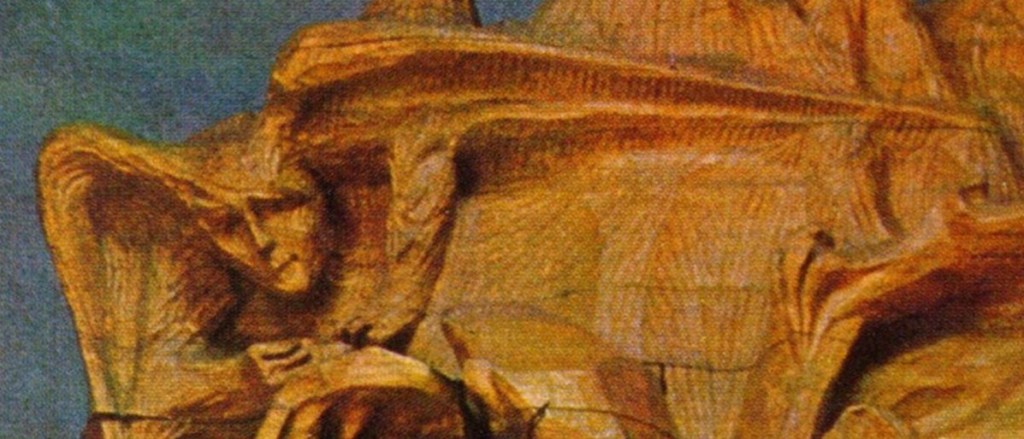
The Representative of Humanity between Lucifer and Ahriman is an eight-meter-high wooden sculpture designed and by carved by Rudolf Steiner and Edith Maryon for the first Goetheanum in Dornach, Switzerland, as the home of the international Anthroposophical Movement founded by Steiner. This sculpture was to be placed on the stage of the first Goetheanum, a magnificent wooden “Temple of Wisdom” that Steiner sometimes referred to as “The House of the Word.” When the Goetheanum burned down on New Year’s Eve in 1922/23, the sculpture had not yet been completed and was housed in an adjacent workshop and was therefore spared from the fire and can still be seen in Dornach in the second Goetheanum.
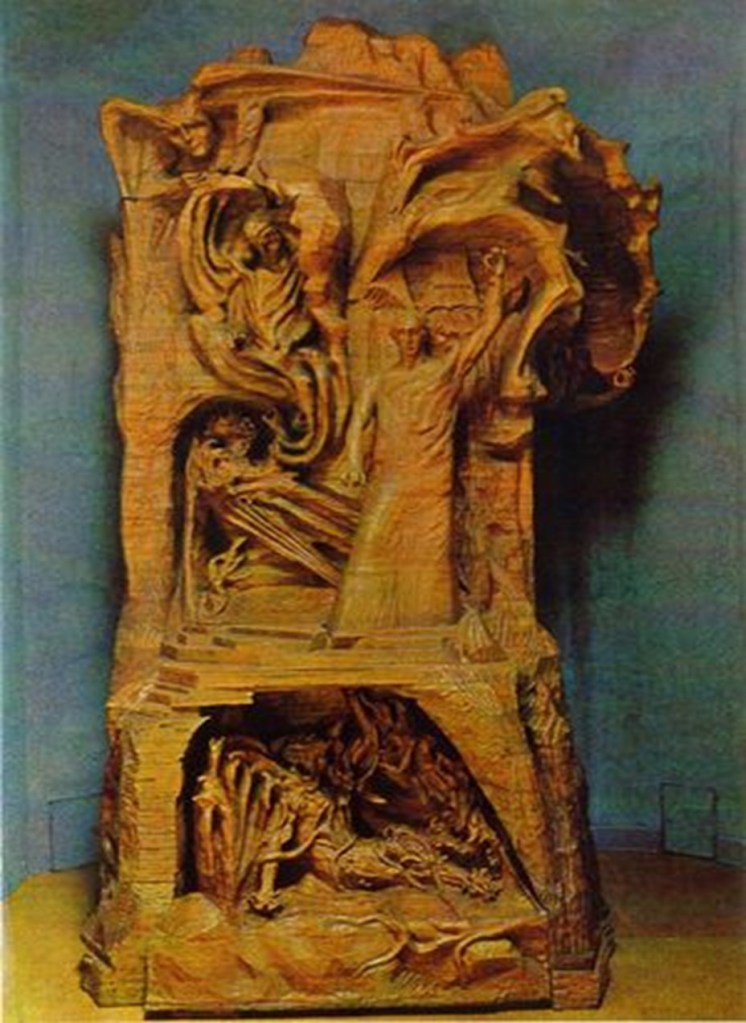
There are two figures of both Lucifer and Ahriman in this sculpture and Christ in-between them as the representative of humanity who is balancing the opposing forces. Ahriman is all that leads humanity to petrification, to sclerosis and death; whereas, Lucifer is all that leads humanity feverishly beyond the measure of that which humans currently is in evolution. Neither Lucifer nor Ahriman have a sense of humor, nor can they see or witness Christ.
Looking down from the top corner of the sculpture is the “Spirit of Humor” or “World Humor” that is an elemental being acting as a cosmic anchor. This smirking figure symbolizes spiritual mobility and detachment, balancing the heavy earthly drama between Christ and the adversary forces of hindrance. This winged, roguish being gazes down over the sculpture’s rock formations introducing a vital counterweight to the intense struggle below. It represents a world-mood that transcends mere tragedy or grandiosity, allowing the human ego to view the complexities of spiritual evolution with a slight, liberating chuckle, a divine sense of humor.
Steiner viewed a sense of humor as a vital “mobility of spirit” necessary for spiritual advancement. He believed humor prevented spiritual researchers from becoming overly rigid, dogmatic, or bogged down by tragedy. He often taught that when the human “I Am” or personal ego, raises itself to laughter, it engages powers of self-liberation. It signifies that a person is refusing to be enslaved by unworthy or base aspects of the world, maintaining an objective, elevated perspective.

The Spirit of Humor elemental being, along with the central figure of Christ mediating between Lucifer and Ahriman, embodies the balance required for modern spiritual development. Or, as Dr. Steiner once said: “Only then will men truly rise to the spiritual, if they do not wish to grasp it with egoistic sentimentality, but can enter into this spiritual region in purity of soul, which can never be without humor. Laughter is nothing other than driving the astral body of the face out of our physiognomy. Laughter is nothing other than an astral exhalation. It is a spiritual expression of our striving for liberation, in order that we may not be entangled in things unworthy of us but with a smile may rise above things to which we should never be enslaved.”
Rudolf Steiner made many remarks about humor to the teachers of the first Waldorf school emphasizing the importance of humor in education and especially in the soul of the teacher. He once told the teachers during a faculty meeting: “There is another thing I find lacking in the teaching, but certainly belongs there, and that is humor. I do not mean making jokes, but genuine humor. Just as human beings must physically breathe, you cannot expect the children to always be taking things in. They must also be able to breathe them out. If you always teach for the whole period in the same tone, it is as though you were to allow the children only to inhale, never to exhale. You must have humor; it is the soul’s exhaling. You must bring humor into your teaching. Humor is something you can find in the most various places. Ultimately, it comes from liveliness. You need to bring some liveliness into the class; the children need that in every grade. A little humor! You must bring humor into the classroom.” (GA 300b)
On another occasion (GA 301) Steiner informed the teachers that: “Once again, it is possible to be very one-sided. Because of your own nature, you could fill your instruction with seriousness, with a face that can never laugh, that can only reprimand. It is also possible, if you have the tendency, to bring very little seriousness into your teaching. Both of these lead to extraordinarily damaging results later in life. It is as if someone were to think about whether inhaling is better than exhaling. Of course, what is important is that human beings must both inhale and exhale; when a person who should exhale wants to inhale, that goes against nature. Just as there is a strict rhythm in the human being according to which there are on the average eighteen breaths taken in a minute, the entirety of human life is based upon rhythm. One part of that rhythm is the interplay between humor and seriousness.
“Humor is based upon people getting away from themselves in a certain way. With humor, we move onto the path toward dreaming. Although we remain completely conscious, moving toward humor is the beginning of the path to dreaming. This loss of self is expressed through smiling or laughing. In these acts, the spirit-soul—or what we in spiritual science call the “I Am” and the astral body—moves out in a certain way from the physical and the etheric, although people still remain in control. Through humor, people expand in their soul and spirit aspects.

“A humorous attitude is an expansion of the soul and spirit, whereas a serious mood brings the spirit-soul aspect of human nature into closer contact with the physical body. We could also say that through laughing, a human being becomes more altruistic, and through seriousness, more egotistic.
“What is important here is that the rhythm in the human being between humor and seriousness supports the soul-spirit life in the same way that inhaling and exhaling support physical life. Just as exhaling is a kind of turning toward the external world and becoming more foreign to oneself, while inhaling gives physical pleasure to a person’s egotism, humor is something whereby the human being expands, and seriousness is something whereby the human being collects himself egotistically. Children need to move between these two moods through a teacher’s guidance. The material itself will provide me with humor and seriousness at the right times, and things will just go by themselves.”
Rudolf Steiner also indicated to the teachers in further discussion with them (GA 305): “Nevertheless, one will sometimes have great trouble in controlling the children’s liveliness. You will succeed in controlling it if you possess a thing not sufficiently appreciated in this connection, namely humor. The teacher must bring humor into the classroom as he enters the door. The fact is, no art of any kind can be mastered without humor, especially the art of dealing with human beings. This means that part of the art of education is the elimination of ill-humor and crossness from the teachers, and the development of friendliness and a love full of humor and fantasy for the children. Art nearly always needs humor. It must not become sentimental.
“Do you know what is the first and most essential qualification for a teacher of children? Humor! Yes, real humor, the humor of life. You may have mastered every possible clever method and device of education, but you will not be able to educate these children unless you have the necessary humor. One can judge contradictory phenomena correctly if one can laugh at them. Humor is needed everywhere for judgment.
“Of course, jokes should not be planned ahead, nor should they be forced on the classroom situation. Everything should be tinted with spontaneous humor, which is inherent within the content, and not artificially grafted onto it. This is the core of the matter. Humor has to be found in things themselves, and above all, it should not even be necessary to search for it.
“Only gradually will it be understood (in education) that we must move from concepts to images, to images that also take in the emotional element, where, in wanting to understand the becoming and weaving of nature, we must also take in what takes place in the human soul as humor, as comedy, alongside the serious. The abstract laws of nature, which are of course far from all comedy and humor, which do not even touch our innermost being, they only represent the poorest becoming and weaving of nature.
“Humor is the dominant power of the soul. It is quite good to laugh about them in the lessons also, for there is nothing better you can bring into the classroom than humor, and it is good for the children to laugh too, for if they always see the teacher come in with a terribly long face they will be tempted to make long faces themselves and to imagine that that is what one has to do when one sits at a desk in a classroom. But if humor is brought in and you can make the children laugh, this is the very best method of teaching. Teachers who are always solemn will never achieve anything with the children.”
Humor is not only needed desperately in the classroom but in life itself to develop new capacities to cope with life’s challenges. Fortunately, there is a sacred courage hidden in humor. Humor faces reality without fear and paralysis. It sees death and still moves forward. It sees absurdity and still chooses kindness. It sees human weakness and still loves humanity. That is no small achievement. Indeed, one might say that humor is love that survives contact with life’s imperfections and human inadequacies.
The humorless person unconsciously demands impossible perfection from life. He expects flawless people, flawless institutions, flawless outcomes. Therefore he becomes perpetually disappointed. But the humorous soul says: “Ah yes—human beings again, the conundrum of life that provides endless humor.” And instead of collapsing into bitterness and rejection, the witty person responds with compassionate amusement and understanding.
Humor protects sanity, and modern life especially requires this capacity. We live amid relentless outrage, ideological combat, technological anxiety, and exhausting selfishness and egotism. People increasingly imitate idols rather than develop their souls and become performers before invisible spiritual audiences. Humor, levity, and laughter interrupts this hypnotic delusion and bursts the bubble of exaggerated egotism. A genuine laugh returns us briefly to immediacy and the humor of life. The body relaxes, our personal demands fall off and vanity loosens its hold as we remember we are alive rather than merely managing appearances.

Shared laughter creates community as strangers quickly become companions through moments of delight and enjoyment. One can only imagine that perhaps heaven itself is filled with laughter and radiant joy beyond our imagination. One might also suspect that eternity is an immense festival of loving recognition where at last we perceive how ingeniously and beautifully everything belongs together. Perhaps then we shall laugh at our frantic anxieties, our swollen vanities, and our tragic misreadings of the divine tenderness that comes with wisdom, compassion, and understanding.
Perhaps God too laughs with infinite affection for these bewildered creatures forever falling and rising again. For humor, at its highest, is inseparable from love. Humor is the profound spiritual capacity to hold truth and tenderness together simultaneously, carefully, reverently, joyfully.
Common wisdom indicates that you should laugh at yourself before life is forced to do it for you more harshly. We should laugh with children due to their innocence and wonder, or with old people who have earned their laughter through long-suffering and patience. We should laugh gently at life’s contradictions, and laugh often enough that bitterness cannot root itself in our soul. For humor is not escape from existence, it is a deep form of fidelity to reality.
We have noticed over time that he most spiritual people are those whose eyes retain a quiet sparkle after having suffered deeply, understood much, forgiven more, and still can smile at the magnificent comedy of being human.
The spiritual person laughs at the thought that: Life is a practical joke of the General upon the Particular.

